AI and the Brain: How Similar Are They?
Artificial neural networks borrowed ideas from neurons. Where they genuinely resemble brain activity, where they differ sharply, and what is still debated.
Key takeaways
- Some vision and language networks develop internal patterns that line up with brain activity.
- They learn differently from brains and need vastly more data.
- Current evidence and expert analysis say they do not think or feel the way people do.
You type a question into a chatbot and it answers in fluent sentences, sometimes with a joke. Your phone recognizes your face in the dark. These systems are built from what are called “neural networks,” which makes it tempting to think they are artificial brains. Are they?
The honest answer is: in a few specific ways they resemble the brain more than scientists expected, and in many other ways they are very different. Untangling which is which is now an active research area in its own right.
Borrowed vocabulary
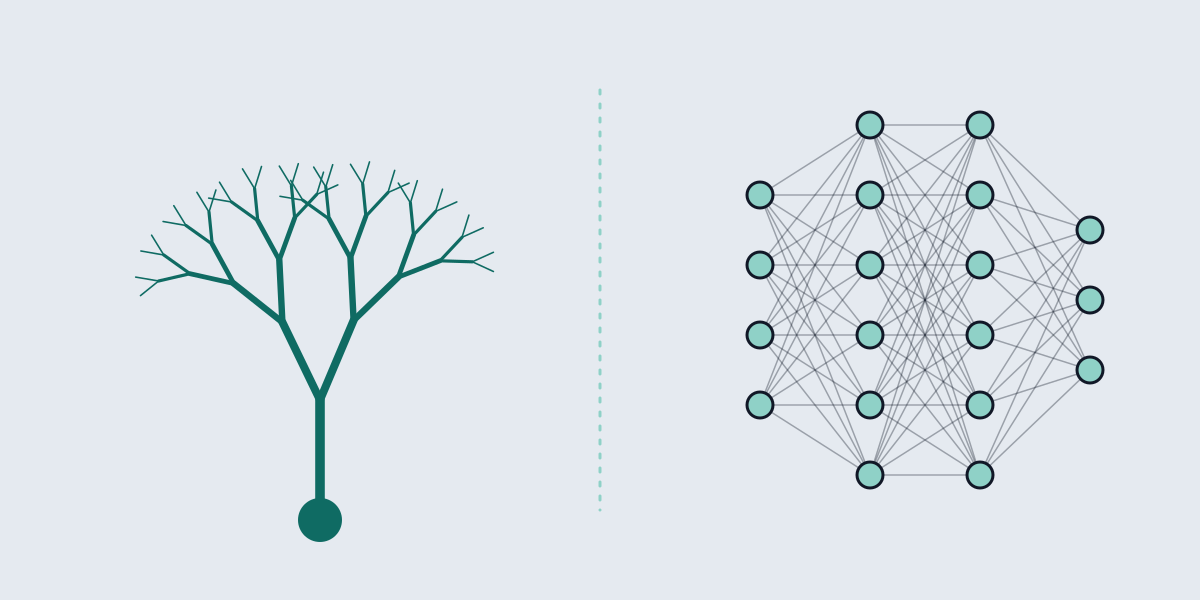
An artificial neural network is a large set of simple mathematical units arranged in layers. Each unit takes in numbers, combines them using adjustable weights, and passes a result on. Training means nudging millions or billions of those weights until the network’s outputs get better at some task. The basic idea was loosely inspired by neurons, which also receive many inputs and send signals onward.
But “loosely” is doing a lot of work. A single real neuron is far more complicated than a single artificial unit. In one study, researchers trained artificial networks to copy the input-output behavior of a detailed computer model of one type of cortical neuron. Capturing it required a network with five to eight layers. When the model neuron’s NMDA receptors, a type of receptor involved in how its dendrites combine inputs, were removed, a much simpler network with one hidden layer was enough. This suggests that one biological neuron may do work closer to a whole small network than to a single artificial unit, although the study modeled a simulated neuron rather than recording a living one.
A surprising match in vision
The strongest evidence for real similarity comes from vision. In the brain, visual information passes through a series of areas called the ventral stream, from early regions that respond to edges toward the inferior temporal (IT) cortex, which responds to whole objects.
In a 2014 study, researchers found that among a family of biologically plausible hierarchical neural network models, the better a model was at recognizing objects, the better it predicted the activity of IT neurons. Their best model was not constrained to match neural data, yet its top layer was highly predictive of IT responses to complex naturalistic images, and its intermediate layers were highly predictive of responses in V4, a mid-level visual area that feeds into IT. In other words, a network trained only to recognize objects ended up with a layered structure of representations that lines up, roughly stage by stage, with the brain’s visual pathway.
And in language
Something similar has been reported for language models. One study recorded brain activity in 102 people reading 400 sentences, using fMRI and MEG, and compared it with the internal activity of many language algorithms. The similarity between algorithms and the brain primarily depends on their ability to predict words from context. The authors concluded that modern language algorithms partially converge toward brain-like solutions. Note the word “partially.” The same authors list differences: the brain is trained with a recurrent architecture and on a relatively small amount of grounded sentences, while these models are massively feedforward and trained on huge text databases.
Where the resemblance breaks down
Matching patterns of brain activity is not the same as working the same way. Critics argue that the success of these comparisons has been overstated. A 2023 critique notes that such predictions may be mediated by networks that share little overlap with biological vision, and that these networks account for almost no results from psychological research on how people actually see.
A well-known example: when shown images in which an object’s shape and its surface texture point to different answers, standard image networks were strongly biased toward recognizing textures rather than shapes, unlike people. Interestingly, the same type of network could learn a shape-based representation instead when trained on stylized images, which shows how much depends on training.
Learning is another big difference. Most artificial networks learn through an algorithm called backpropagation, which computes synaptic updates using feedback connections to deliver error signals. It has historically been viewed as biologically problematic: although the cortex is full of feedback connections, it is difficult to see how they could deliver the error signals required by strict formulations of backpropagation. Some researchers argue the brain may approximate it in other ways, but this remains a hypothesis.
Then there is the amount of experience. Large language models receive around four or five orders of magnitude more language data than human children, which is roughly ten thousand to a hundred thousand times more. And the brain does all its work on an energy budget of about 20 watts, less than the computer the author of that paper was writing on.
Do language models think?
Fluent language can feel like evidence of a mind. Researchers caution against that leap. One paper separates formal linguistic competence, knowledge of linguistic rules and patterns, from functional competence, understanding and using language in the world. In the human brain, these rely on different neural mechanisms. The authors argue that large language models are surprisingly good at formal competence, while their performance on functional competence tasks remains spotty.
What about consciousness? A 2023 report by a group of researchers derived “indicator properties” from leading scientific theories of consciousness and checked current AI systems against them. Their analysis suggests that no current AI systems are conscious, but also that there are no obvious technical barriers to building AI systems which satisfy these indicators. That report was not peer reviewed, and there is no scientific agreement on how consciousness arises even in humans, so any verdict here is provisional.
What is uncertain
Much depends on what “similar” means. Two systems can produce similar patterns of activity for different reasons, and current methods cannot always tell those reasons apart. AI also changes quickly, so comparisons made with one generation of models may not hold for the next. And neuroscience itself has major open questions about how the brain learns, which makes it hard to say exactly what an artificial system would need to match.
The takeaway
Artificial neural networks were inspired by the brain, and some, especially in vision and language, develop internal patterns that line up with brain activity better than earlier models did. That makes them useful tools for neuroscience. But they learn differently, need vastly more data and, according to current evidence and expert analysis, do not think or feel the way people do. A fair summary might be that AI and the brain have arrived at some similar solutions by very different routes.
References
- Performance-optimized hierarchical models predict neural responses in higher visual cortex. Yamins DLK, Hong H, Cadieu CF, Solomon EA, Seibert D, DiCarlo JJ, PNAS 111(23):8619–8624, 2014. doi:10.1073/pnas.1403112111
- Brains and algorithms partially converge in natural language processing. Caucheteux C, King JR, Communications Biology 5:134, 2022. doi:10.1038/s42003-022-03036-1
- Deep problems with neural network models of human vision. Bowers JS, Malhotra G, Dujmović M, et al., Behavioral and Brain Sciences 46:e385, 2023 (published online 2022). doi:10.1017/S0140525X22002813
- ImageNet-trained CNNs are biased towards texture; increasing shape bias improves accuracy and robustness. Geirhos R, Rubisch P, Michaelis C, Bethge M, Wichmann FA, Brendel W, International Conference on Learning Representations (ICLR), 2019. arXiv:1811.12231
- Single cortical neurons as deep artificial neural networks. Beniaguev D, Segev I, London M, Neuron 109(17):2727–2739, 2021. doi:10.1016/j.neuron.2021.07.002
- Backpropagation and the brain. Lillicrap TP, Santoro A, Marris L, Akerman CJ, Hinton G, Nature Reviews Neuroscience 21(6):335–346, 2020. doi:10.1038/s41583-020-0277-3
- Bridging the data gap between children and large language models. Frank MC, Trends in Cognitive Sciences 27(11):990–992, 2023. doi:10.1016/j.tics.2023.08.007
- Dissociating language and thought in large language models. Mahowald K, Ivanova AA, Blank IA, Kanwisher N, Tenenbaum JB, Fedorenko E, Trends in Cognitive Sciences 28(6):517–540, 2024. doi:10.1016/j.tics.2024.01.011
- Brain power. Balasubramanian V, PNAS 118(32):e2107022118, 2021. doi:10.1073/pnas.2107022118
- Consciousness in Artificial Intelligence: Insights from the Science of Consciousness. Butlin P, Long R, Elmoznino E, et al., arXiv:2308.08708, 2023 (report, not peer reviewed)